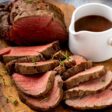

Beef Tenderloin Roast
Equipment
Ingredients
Beef Tenderloin
- 2-3 pounds beef tenderloin roast, trimmed
- Sea salt or Kosher salt, about ½ teaspoon per pound
- Freshly ground black pepper, about ¼ teaspoon per pound
- 1 - 2 tablespoon olive oil
Red Wine Butter Sauce
- 8 tablespoons unsalted butter, softened, divided
- 2 large shallots, finely chopped
- 1 ¼ cups red wine
- 3 cups beef broth or stock
- 3 fresh thyme sprigs
- 1/4 teaspoon kosher salt
- 1/8 teaspoon ground black pepper
- 1 teaspoon sugar
- 2 tablespoons all-purpose flour
Instructions
Prepare the Wine Sauce:
- In a medium saucepan over medium-low heat, melt 5 tablespoons of butter. Add the shallots and cook stirring occasionally for about 5-7 minutes or until soft and translucent. Add the wine, beef broth, thyme sprigs, salt, pepper, and sugar, and bring to a boil. Cook over medium heat for about 35-45 minutes, or until the liquid is reduced by about half.

- While the wine mixture is reducing, place the remaining 3 tablespoons of softened butter in a small bowl and add the flour. Mix the butter and flour until a smooth paste is formed.
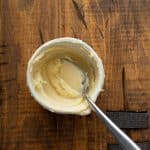
- Once the wine mixture is reduced, remove it from the heat and strain the sauce through a fine mesh strainer. Discard the solids then, return the wine mixture to the saucepan.

- Return the saucepan to the stove and simmer over medium-low heat. Gradually, whisk in the flour mixture into the wine mixture and simmer until thickened, about 2-3 minutes. Remove from the heat and set aside.You can make the sauce up to this point 2 days in advance.

Prepare the Beef Tenderloin:
- Remove the beef tenderloin from the refrigerator about an hour before roasting and allow it to sit at room temperature.
- Using a thin sharp knife (like a utility or paring knife), trim the silver skin (the silver thin membrane of chewy connective tissue on the beef surface). Then, tie the tenderloin. If one end is more tapered than the other, bend it under the roast and secure it when tying so the roast is an even thickness throughout.

- Pat dry the beef tenderloin and season it generously with salt and ground black pepper. Let the beef stand at room temperature for 1 hour.
Cook the Beef Tenderloin:
- Set an oven rack in the middle position and preheat the oven to 400 degrees Fahrenheit.
- Heat the oil in a large oven-proof skillet over medium-high heat (a cast iron skillet works well). When the oil is hot, place the roast in the skillet and sear the meat on all but one side until golden brown. With kitchen tongs, turn the meat so that the un-seared side is down.

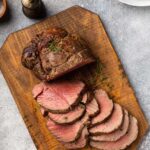
- Transfer the skillet to the pre-heated oven and roast for about 15 minutes, depending on the size of your roast, until an oven-safe meat thermometer inserted into the thickest part of the tenderloin registers 120 degrees Fahrenheit for medium rare, or until your desired doneness is reached. The temperature of the meat will continue to rise about 5 degrees after it is removed from the oven while it is resting, before slicing.

- Transfer the beef roast to a cutting board or platter and allow it to rest, covered loosely with aluminum foil, for about 10 minutes.
- Meanwhile, carefully discard some of the fat from the skillet. Set the pan on the stovetop and add the 1/4 cup of beef broth. Bring to a boil and using a wooden spoon scrape the brown bits from the bottom of the pan.
- Remove the skillet from the heat and add the broth from the skillet to the red wine sauce. Mix to combine and then bring the sauce to a simmer over low heat for about 2-3 minutes. Remove from the heat.
- Slice the beef tenderloin and serve with the wine sauce.

Notes
Beef Tenderloin Temperature Guide
RARE
Pull the Steak: 120 degrees
Serving Temperature: 125 degrees
MEDIUM-RARE
Pull the Steak: 125 degrees
Serving Temperature: 130 degrees
MEDIUM
Pull the Steak: 135 degrees
Serving Temperature: 140 degrees
WELL DONE: 150 degrees +
RARE
Pull the Steak: 120 degrees
Serving Temperature: 125 degrees
MEDIUM-RARE
Pull the Steak: 125 degrees
Serving Temperature: 130 degrees
MEDIUM
Pull the Steak: 135 degrees
Serving Temperature: 140 degrees
WELL DONE: 150 degrees +
- Roast beef tenderloin is very lean which means it's very easy to over cook it. Make sure you check the internal temperature to prevent overcooking which will result in dry and tough meat.
- Make sure you remove the silver skin from the tenderloin. This tough layer of connective tissue is tough and often causes the meat to curl up.
- Season the beef liberally. Tenderloin is a big piece of meat with very mild flavor. Seasoning it properly is a must.
- Allow the roasted beef tenderloin to rest before slicing.
Nutrition
Calories: 398 kcal, Carbohydrates: 8 g, Protein: 3 g, Fat: 34 g, Saturated Fat: 16 g, Cholesterol: 60 mg, Sodium: 823 mg, Potassium: 234 mg, Fiber: 1 g, Sugar: 2 g, Vitamin A: 735 IU, Vitamin C: 2 mg, Calcium: 31 mg, Iron: 1 mg
